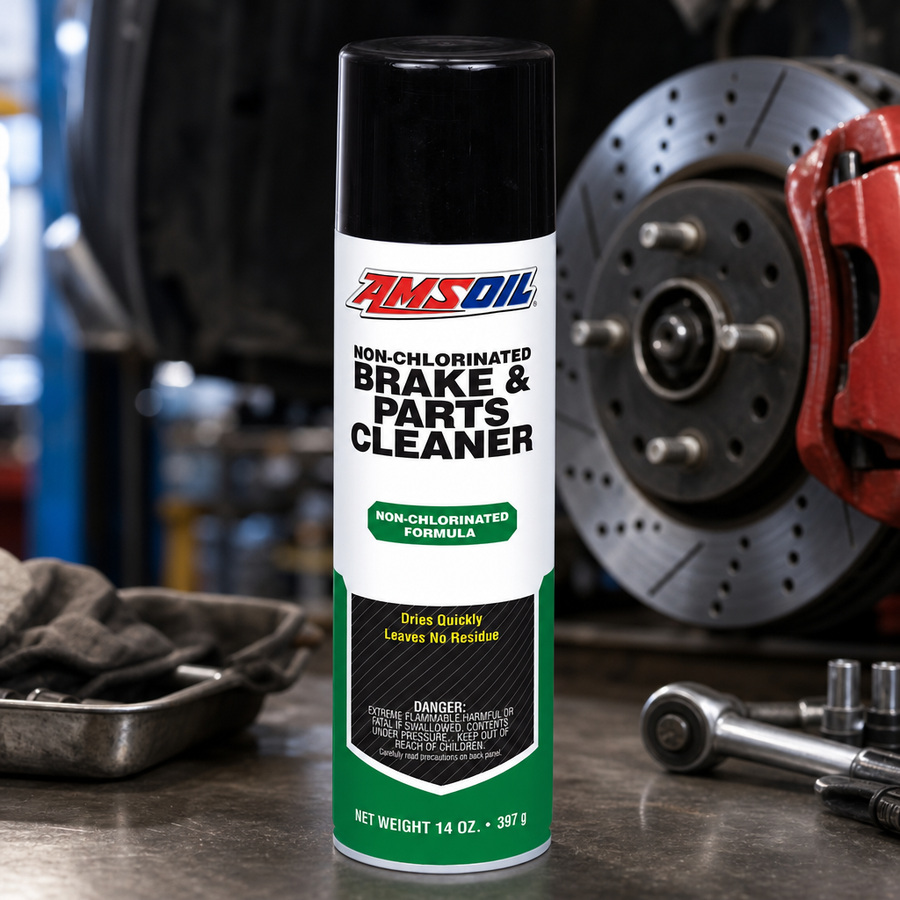
AMSOIL Non-Chlorinated Brake and Parts Cleaner
AMSOIL Non-Chlorinated Brake and Parts Cleaner is a fast-drying, residue-free aerosol degreaser formulated for brake assemblies and other automotive parts where a chlorinated solvent base is not permitted. The non-chlorinated formula stays on the shelf in California, New Jersey, Canada, and other jurisdictions that restrict chlorinated brake cleaners, while still cutting brake dust, grease, oil, and brake fluid from pads, calipers, rotors, and drums.
Non-chlorinated chemistry available in all 50 states
The chlorinated AMSOIL Brake and Parts Cleaner (BPC) ships in a 19-ounce can but cannot be sold in California, New Jersey, or Canada. AMSOIL Non-Chlorinated Brake and Parts Cleaner (NCBC) covers that gap as the regulatory-compliant version for those markets. The 14-ounce aerosol is available in all 50 states and serves shops, dealers, and DIY mechanics who need a compliant brake-side degreaser without losing cleaning performance. The Safety Data Sheet confirms the formula contains no California Proposition 65 listed chemicals.
Acetone-based formula cuts brake dust, grease, and brake fluid
The cleaner uses an acetone-led solvent blend (acetone 75 to 90 percent, branched, cyclic, and linear heptanes 5 to 10 percent) propelled by carbon dioxide (5 to 10 percent). Acetone is the active workhorse for dissolving glycol-based brake fluid that petroleum solvents struggle to lift, polishing oil films off pads and rotors, and stripping baked-on grease from caliper hardware. The result is no major disassembly required to flush a contaminated brake assembly back to a clean working surface.
Dries fast and leaves no residue
Acetone has a high vapor pressure (approximately 2.4 x 10^4 Pa at 20 degrees C), which drives the solvent off the part within seconds and leaves the surface dry. No oily film remains to glaze new pads, contaminate fresh pad bedding, or trigger brake squeal and chatter after reassembly. Equipment can be returned to service shortly after the spray flashes off, provided ignition sources have been removed and ventilation is adequate.
Safe on common brake hardware
The formula is intended for brake pads, calipers, drums, rotors, and other brake parts, plus general automotive degreasing on bare metal surfaces. Strong solvents can attack rubber, painted, and plastic surfaces, so a small inconspicuous test patch should be sprayed first before treating any rubber boot, plastic ABS sensor housing, or painted finish. Overspray onto unintended surfaces should be wiped off promptly to avoid softening or staining.
Pressurized aerosol with precision-spray straw
The 14-ounce can ships with an extension straw for tight-clearance work around caliper guide pins, brake hose fittings, and parking brake hardware. The contents are an extremely flammable aerosol (UN1950, hazard class 2.1, flash point -17 degrees C / 1.4 degrees F based on acetone), so the can must be kept away from open flame, hot surfaces, and ignition sources. The product must never be sprayed on running equipment or hot brake components.
Recommended applications and service intervals
Non-Chlorinated Brake and Parts Cleaner is a service consumable rather than a fluid with a drain interval. Standard procedure is to shake the can well, start at the top of the assembly, and wash contaminants downward and off the part. Repeat application is appropriate when parts are extremely contaminated. Typical applications include:
- Brake pads, calipers, rotors, drums, and brake hardware before reassembly.
- Wheel hubs, knuckles, and suspension components for grease and dust removal.
- General engine and chassis parts that need a fast-flash degreaser, with a test patch first on any rubber, painted, or plastic surface.
- Service environments inside California, New Jersey, Canada, and other jurisdictions that restrict chlorinated brake cleaners.
The product is not designed for cleaning electrical contacts. Use a dedicated electrical contact cleaner for sensors, relays, and connectors. Never apply the cleaner to running equipment or hot surfaces, and pair every application with proper PPE: nitrile gloves, splash-rated eye protection, and adequate ventilation. The AMSOIL Limited Liability Warranty backs the product when used in the intended applications and according to the directions on the label and the Safety Data Sheet.
Typical technical properties
| Property | Value |
|---|
| Product code | NCBCSC |
| Container | 14 oz aerosol spray can |
| Physical state | Aerosol; colorless liquid |
| Odor | Acetone |
| Primary solvent (CAS 67-64-1) | Acetone, 75 to 90 percent by weight |
| Co-solvent (CAS 426260-76-6) | Heptane (branched, cyclic, linear), 5 to 10 percent |
| Propellant (CAS 124-38-9) | Carbon dioxide, 5 to 10 percent |
| Flash point (acetone basis) | -17 degrees C / 1.4 degrees F |
| Lower flammability limit (acetone basis) | 2.5 percent v/v |
| Upper flammability limit (acetone basis) | 12.8 percent v/v |
| UN number / hazard class | UN1950, Class 2.1 (flammable aerosol) |
| California Proposition 65 | No listed chemicals |
Order AMSOIL Non-Chlorinated Brake and Parts Cleaner
AMSOIL Non-Chlorinated Brake and Parts Cleaner ships in two configurations: a single 14 oz aerosol can (NCBCSC-EA) for individual service work and a case of twelve 14 oz cans (NCBCSC-CA) for shops and high-volume users. Both package sizes are available in all 50 states and are backed by the AMSOIL Limited Liability Warranty when used in the intended applications described on the product label and Safety Data Sheet. To match the cleaner to a specific vehicle service interval, see the AMSOIL vehicle lookup guide, and for the full maintenance lineup see the AMSOIL product catalog. Order online: AMSOIL Non-Chlorinated Brake and Parts Cleaner.
Frequently asked questions
What is the difference between AMSOIL Brake and Parts Cleaner and the non-chlorinated version?
AMSOIL Brake and Parts Cleaner (BPC) uses a chlorinated solvent base and ships in a 19-ounce can, but it is not available in California, New Jersey, or Canada. AMSOIL Non-Chlorinated Brake and Parts Cleaner (NCBC) is the acetone-based 14-ounce version that is available in all 50 states and meets the regulatory requirements that block chlorinated formulas in those jurisdictions. Cleaning performance on brake dust, grease, oil, and brake fluid is comparable.
Is this brake cleaner legal in California?
Yes. The non-chlorinated formula is the version intended for California, New Jersey, Canada, and any other market that restricts chlorinated brake cleaners. The Safety Data Sheet confirms the formula contains no California Proposition 65 listed chemicals.
Will the cleaner damage rubber, plastic, or painted surfaces?
The acetone-based formula can attack many rubbers, plastics, and paints if it is allowed to dwell. Standard procedure is to test on a small inconspicuous area before spraying any rubber boot, plastic housing, or painted finish, and to wipe off overspray promptly. Direct contact with brake pads, calipers, rotors, drums, and bare metal hardware is the intended use.
Does the cleaner leave a residue on brake parts?
No. The formula is designed to flash off cleanly and leave no oily film, which helps eliminate brake squeal and chatter on freshly serviced pads and rotors. Drying time is fast because the acetone-led solvent blend has a high vapor pressure.
Can it be sprayed on hot brakes or running equipment?
No. The contents are an extremely flammable aerosol (UN1950, Class 2.1) with a flash point of -17 degrees C / 1.4 degrees F. The product must not be applied to hot surfaces, sprayed on an open flame, or used on equipment that is running. The vehicle should be off, the brakes should be cool, and the work area should be well-ventilated and free of ignition sources.
Is it suitable for cleaning electrical components?
No. This cleaner is formulated for brake assemblies and general automotive degreasing on bare metal, not for electrical contacts. A dedicated electrical contact cleaner is the right choice for sensors, relays, and wiring connectors. The acetone base can also damage conformal coatings and certain plastics found in connector housings.
What does the AMSOIL Limited Liability Warranty cover?
The AMSOIL Limited Liability Warranty applies when the cleaner is used for its intended applications and in accordance with the directions on the label and the recommendations in the Safety Data Sheet. Misuse outside of those conditions, including spraying on hot surfaces, ignition sources, or running equipment, falls outside the warranty.