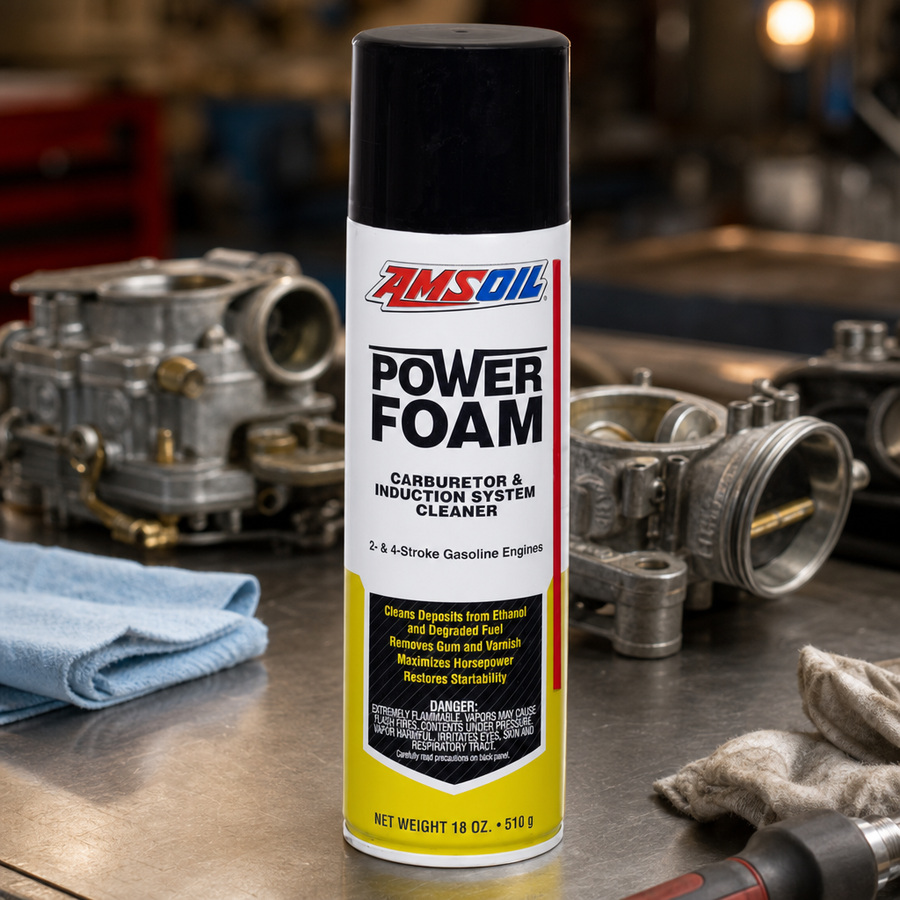
AMSOIL Power Foam® Carburetor and Induction-System Cleaner
Powerful foaming agents remove stubborn deposits, varnish and gum left by ethanol or degraded fuel in carbureted and fuel-injected engines. Restores startability and smooth operation while maximizing horsepower. Especially effective in powersports and small-engine applications that run, then sit for extended periods.
Add an AMSOIL Preferred Customer membership to the same cart to unlock up to 25% off qualifying products. Existing members can sign in, and qualifying orders currently over $100 can ship free.
Product data sheets
View, download, or save a copy of the Product Data Sheet or Safety Data Sheet for AMSOIL Power Foam® Carburetor and Induction-System Cleaner.
AMSOIL Power Foam Carburetor and Induction-System Cleaner
AMSOIL Power Foam (APF) is a foaming aerosol intake cleaner formulated for carbureted and fuel-injected gasoline engines. The chemistry dissolves gum, varnish, and carbon deposits left behind by ethanol-blended pump fuel and by fuel that has been sitting in the tank, fuel bowl, or intake tract. Power Foam targets the equipment most prone to deposit buildup, including automotive throttle bodies, motorcycle and ATV carburetors, marine outboard induction systems, and small engines that run hard, then sit for months between uses.
Removes ethanol-fuel deposits from carburetors, throttle bodies, and intake tracts
Power Foam dissolves the gum, varnish, and carbon that build up on intake valves, intake manifolds, throttle plates, and carburetor passages. Those deposits restrict airflow, foul idle circuits, and disturb the fuel-air mixture, which shows up as rough idle, hesitation, hard starting, ping, and lost horsepower. APF clears the deposits and restores the original air-metering geometry of the carb or throttle body without disassembly. The same chemistry that strips varnish from a flooded carb bowl is what loosens the brown crust that coats intake valves on a port-injected engine.
Power Foam is intended for two- and four-stroke gasoline engines. It is not recommended for diesel engines, gasoline direct-injection (GDI) engines, or as a general-purpose degreaser. For a complete fuel-system service on small engines, motorcycles, marine outboards, and stored equipment, pair the intake-tract treatment with the matching fuel-additive product covered in the AMSOIL Quickshot guide.
Foaming action clings to vertical and overhead surfaces
An aerosol cleaner that flashes off the moment it touches metal cannot scrub deposits that sit on the back of an intake valve, the underside of a throttle plate, or the roof of an intake runner. Power Foam dispenses as a thick foam that clings to vertical and overhead surfaces, then breaks down to a liquid as it works the deposit. The dwell time is what does the work, which is why the directions call for spraying enough product to choke out the engine, then letting it sit for 10 to 15 minutes before restart.
Safe for fuel injectors, catalytic converters, and emissions hardware
Modern gasoline engines route every cleaner that passes through the intake past oxygen sensors, three-way catalysts, and evaporative-emissions hardware. Power Foam is safe for fuel injectors, catalytic converters, and emissions-control devices when used as directed. The formula will not damage seals, gaskets, rubber, or plastic materials commonly used inside gasoline engines, so it is compatible with the elastomers found in injector tips, intake-manifold gaskets, throttle-body O-rings, and PCV connections. Mass-airflow sensors are the one in-system component that should be shielded from direct spray, since the heated wire or hot-film element can be damaged by solvent contact at full strength.
Restores startability and recovers horsepower in seasonal equipment
Powersports vehicles and small engines sit for long periods between use. Snowblowers sit through summer, lawn mowers sit through winter, and outboards and motorcycles often sit through the off-season with partially full tanks. Ethanol-blended fuel separates and oxidizes during storage, leaving sticky varnish behind in the carb bowl and on the needle, jet, and main circuit. Power Foam loosens those deposits in place, which makes it a routine first step when bringing seasonal equipment back into service.
Helps improve fuel economy and reduce pollution
Carbon and varnish on intake valves, throttle plates, and carburetor circuits force the engine to run richer than the calibration intends, which wastes fuel and pushes more unburned hydrocarbons into the exhaust. Restoring the intake geometry with Power Foam recovers the air-fuel ratio the manufacturer engineered into the engine and helps reduce engine ping caused by combustion-chamber and intake-valve deposits.
Recommended applications and service intervals
Power Foam is intended for two- and four-stroke gasoline engines across automotive, powersports, marine, and small-engine equipment. Apply it as a periodic induction-system service or as a corrective treatment when symptoms point to intake deposits or stale-fuel varnish. The 18 oz aerosol is sized for a single complete treatment on most engines, including a follow-up application as needed.
Cars, light trucks, and motorcycles with carbureted or port-injected gasoline engines.
Marine outboards, ATVs, UTVs, snowmobiles, and other powersports gasoline engines.
Lawncare equipment, tractors, generators, and other four-stroke and two-stroke small engines.
Not for diesel engines, gasoline direct-injection (GDI) engines, or general-purpose degreasing duty.
Run the engine to normal operating temperature, remove the air-cleaner assembly, and shield painted surfaces and the mass-airflow sensor before applying. Spray Power Foam into the throttle body or carburetor throat while the engine is running, revving as needed to keep it from stalling. Spray enough product to choke out the engine, shut it off, and let it sit for 10 to 15 minutes. Reinstall the air cleaner, restart, and repeat the application as needed. After treatment on a four-stroke engine, follow with an oil change to clear any deposit residue that has worked past the rings into the crankcase. To match the right oil, filter, and fuel additive to the engine being serviced, start with the AMSOIL vehicle lookup guide. Product availability is restricted in some markets; Power Foam is not currently sold in Canada or California.
Order AMSOIL Power Foam Carburetor and Induction-System Cleaner
Power Foam ships as an 18 oz spray can (APFSC-EA) and as a case of twelve 18 oz spray cans (APFSC-CA). Both pack sizes are sold under the AMSOIL Limited Warranty. To match the right product to a specific vehicle, motorcycle, ATV, UTV, outboard, or piece of equipment, start with the AMSOIL vehicle lookup guide, then pair the intake-tract treatment with the seasonal fuel-stabilizer recommendation in the AMSOIL Quickshot guide. Order Now.
Used to decarbonize Honda lawnmower at beginning of season.
By Mark from Springfield, Missouri on May 19, 2026.
Would recommend this to a friend.
Excellent results
I saw this cleaner demonstrated by a popular automotive youtuber so I thought I would give it a try. It worked extremely well on my Harley Davidson's throttle body.
Is AMSOIL Power Foam safe for catalytic converters and oxygen sensors?
Power Foam is safe for fuel injectors, catalytic converters, and emissions-control devices when used as directed. Shield the mass-airflow sensor from direct spray, since hot-wire and hot-film MAF sensors can be damaged by solvent contact at full strength.
Can Power Foam be used on a GDI (gasoline direct-injection) engine?
Power Foam is not recommended for GDI engines. The chemistry is designed for port-injected and carbureted gasoline engines where the cleaner can reach intake valves and intake manifolds through the throttle body. On GDI engines, the injector sprays past the intake valve, so an in-tank fuel additive or an OEM-specified intake-valve service is the correct cleaning method instead of an intake-side aerosol.
How does Power Foam differ from a fuel-additive injector cleaner?
A fuel-additive injector cleaner is poured into the fuel tank and cleans the wetted side of the fuel system, including injector tips, fuel rails, and combustion chambers. Power Foam is sprayed directly into the air intake or carburetor throat and cleans the air side of the induction system, including intake valves, intake manifolds, throttle plates, and carburetor circuits. The two cleaners target different deposits and are commonly used together as part of a full fuel-system service.
Will Power Foam fix a carburetor that has sat with stale fuel?
Power Foam dissolves gum and varnish left by ethanol-blended fuel and degraded fuel, which is the same residue that causes a stored carburetor to run rich, run lean, or refuse to idle. In light to moderate cases, an in-engine treatment with the 10 to 15 minute dwell time will restore startability and idle quality. In extreme cases, the carburetor should be disassembled and the parts soaked.
Should the oil be changed after a Power Foam treatment?
On four-stroke engines, an oil change is recommended after treatment. Some of the dissolved deposit residue can wash past the rings into the crankcase during the soak step, which contaminates the existing oil charge. Drain the oil, change the filter, and refill with the viscosity grade and specification the engine manufacturer calls for in the application.
Can Power Foam be used as a general parts degreaser?
Power Foam is not formulated as a general-purpose degreaser. The chemistry is designed to dissolve fuel-related deposits inside gasoline engines, not to remove grease, oil, or road grime from exterior parts. Avoid contact with hoses, exterior plastics, and painted surfaces, and wipe off any overspray immediately to prevent component damage. Test on a small area before using on rubber, painted, or plastic surfaces.
Where can Power Foam be shipped?
Power Foam is not currently sold in Canada or in California. The 18 oz aerosol ships as APFSC-EA (each) or APFSC-CA (case of twelve cans), both backed by the AMSOIL Limited Warranty.