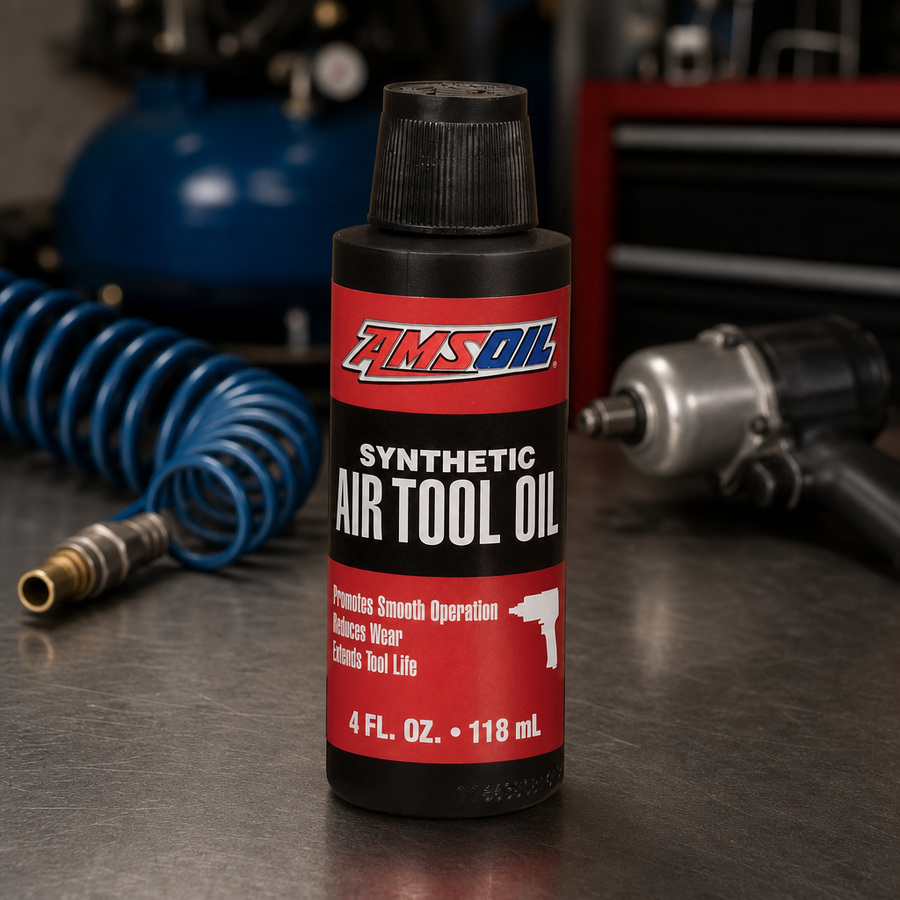
AMSOIL 100% Synthetic Air Tool Oil
AMSOIL 100% Synthetic Air Tool Oil (AIR) is a dedicated synthetic lubricant for the air motors inside pneumatic shop tools. The formula effectively lubricates rotary- and piston-type air-tool bearings and motors, manages moisture carried in compressed-air supply lines, and conditions the rubber and plastic seals and O-rings that keep tool internals sealed. Synthetic Air Tool Oil is built for technicians, fabricators, mechanics, and serious DIY shops that want longer service life from impact wrenches, ratchets, grinders, drills, sanders, hammers, and other compressed-air tools.
Wear protection for rotary and piston air motors
Air-tool motors run at high rotational speeds with the lubricant feeding through the inlet, atomizing in the air stream, and coating internal hardware as it passes through. Synthetic Air Tool Oil keeps a consistent fluid film on vanes, rotors, ball bearings, and pistons so metal-to-metal contact stays low under load. Reduced wear extends tool life, holds rated torque on impact wrenches, and keeps die grinders, drills, and sanders running smooth across long shop days.
Corrosion and deposit control
Compressed air supplies pull humidity into the tool with every cycle, and condensed water can rust internal hardware between uses. The synthetic formula helps prevent corrosion and deposits, allowing air tools to run cleanly and reliably even in damp shop environments, mobile service trucks, and unheated garages. Clean internals also keep exhaust ports clear and the air motor making rated power, instead of bogging from gum and varnish on the vanes.
Moisture management in supply lines
Shop compressors and remote air supplies routinely send moisture, fine particulate, and trace thread sealants downstream. Synthetic Air Tool Oil manages moisture inside the tool so water does not pool in rotor cavities or wash the protective film off wear surfaces. The result is consistent torque on impact and ratchet wrenches, steady speed on cut-off tools and die grinders, and a quieter exhaust note across the shift.
Seal and O-ring conditioning
Stiff or split seals leak air around the throttle valve and reduce tool power. Synthetic Air Tool Oil conditions rubber and plastic seals and O-rings so the elastomers stay flexible, trigger response stays crisp, and the exhaust direction stays where the operator set it. Conditioned seals also stretch the time between rebuild kit replacements on shop-favorite ratchets, impact wrenches, and rivet tools.
Easy daily dispensing
The 4-ounce bottle is sized for the way technicians actually lubricate air tools, with a tip that meters drops directly into the air inlet. The formula pours cleanly at room temperature, dispenses without stringing, and does not gum the inlet ports between uses. A single 4-ounce bottle covers a busy mobile-service kit through an extended stretch of impact, ratchet, drill, and grinder work, and fits inside a standard tool roll or top-box drawer.
Recommended applications and service intervals
Synthetic Air Tool Oil suits the broad family of pneumatic shop tools driven by compressed air. Apply 3 to 5 drops directly into the air inlet before use, again after use, and any time a tool sits unused for an extended period. For tools fed by an in-line oiler in an FRL (filter, regulator, lubricator) module, fill the lubricator reservoir with this oil and adjust the metering screw per the FRL manufacturer instructions. Tools used outside the United States and Canada should follow the local AMSOIL-recommended service guidance for the destination country.
- Rotary air tools: die grinders, angle grinders, sanders, drills, and cut-off tools.
- Percussion and impact tools: impact wrenches, ratchet wrenches, hammers, chisels, riveters, and nailers.
- Pair the lubricator with an inline air filter and water trap so particulate and bulk water never reach the tool.
- Not formulated as a hydraulic fluid, gear oil, or compressor crankcase oil. Match those applications to the correct product family.
For shop air systems and FRL kits, Synthetic Air Tool Oil drops in alongside standard regulators and water separators. Avoid topping off the bottle with general-purpose 3-in-1 lubricants, kerosene, diesel, or chain oils, which can leave gum, separate under pressure, and soften pneumatic seal compounds. Mixing with another brand of dedicated air tool oil is unlikely to harm the tool, though sticking with one synthetic formula keeps performance predictable.
Order AMSOIL 100% Synthetic Air Tool Oil
Available sizes are AIRBA-EA (4 oz. bottle, each) and AIRBA-CA (case of twelve 4-ounce bottles). The product is backed by the AMSOIL Limited Liability Warranty. To match the right AMSOIL lubricants and filters to a vehicle, fleet, or specific machine, see the AMSOIL vehicle lookup guide. For separate ISO-graded shop hydraulic systems and the difference between hydraulic, compressor, and air tool fluids, see the ISO hydraulic oil guide. Place an order through the official product page: Order Now.
Frequently asked questions
What is air tool oil and where does it go?
Air tool oil is a low-viscosity lubricant added directly to the air supply of a pneumatic tool. Drops go into the air inlet on the tool itself, or into the reservoir of an in-line oiler attached to the shop air line as part of an FRL module. The compressed air carries the oil through the tool, lubricating bearings, vanes, rotors, and seals as it passes from inlet to exhaust.
How many drops of oil should an air tool get?
Apply 3 to 5 drops into the air inlet before each use and again after each use. Tools that run continuously, such as cut-off wheels and high-speed sanders, benefit from a constant-feed oiler set to the FRL manufacturer specification. Tools that sit between jobs benefit from a fresh shot of oil before storage to coat internal surfaces and slow corrosion during downtime.
Can motor oil, ATF, or 3-in-1 oil be used in air tools?
Substituting motor oil, automatic transmission fluid, or general household oils is not recommended. Motor oils are too viscous to atomize through an air motor cleanly, ATF can attack pneumatic seal compounds, and 3-in-1 type oils tend to gum on internal hardware. A dedicated synthetic air tool oil is formulated for the temperature, viscosity, and seal-compatibility window that compressed-air tools actually need.
Does air tool oil help prevent rust inside the tool?
Yes. Compressed air carries condensed water into the tool, and an unlubricated air motor can rust on internal steel parts during overnight or weekend storage. Synthetic Air Tool Oil helps prevent corrosion and deposits, leaves a protective film on bearings and vanes, and resists washoff so the tool stays dry-running but rust-free between uses.
Will using AMSOIL synthetic lubricants void a tool warranty?
No. Using AMSOIL synthetic lubricants does not void the warranty on a properly maintained pneumatic tool. The Magnuson-Moss Warranty Act protects the right to choose a quality lubricant, and AMSOIL products are themselves backed by the AMSOIL Limited Liability Warranty.
How does this oil work with an FRL or in-line lubricator?
Pour the oil into the lubricator reservoir of the FRL module, then adjust the metering needle so the sight glass shows roughly one drop of oil per tool cycle, or per the FRL manufacturer specification. The shop air picks up the oil mist and delivers it downstream to every tool fed by that line. Drain the FRL water trap regularly to keep bulk moisture out of the lubricator reservoir.
How is air tool oil different from compressor oil and hydraulic oil?
Air tool oil rides downstream of the compressor and lubricates the air motor inside the tool. Compressor oil stays inside the compressor crankcase and lubricates the pump itself. Hydraulic oil runs in a closed pressurized system to transmit force in cylinders and motors. The three fluids are formulated for different viscosity grades, additive packages, and seal compatibility profiles, and substituting one for another shortens equipment life.