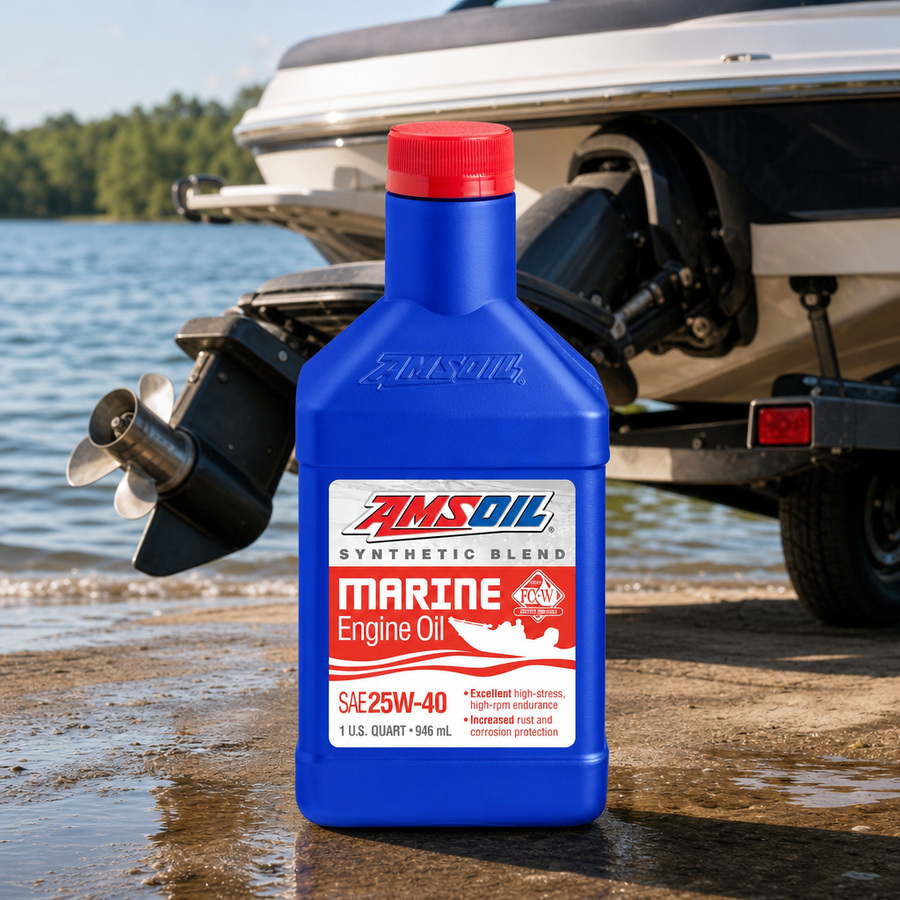
Engine performance and reliability are key to a successful day fishing or boating. High-rpm operation and constant exposure to water, however, invite engine wear and formation of rust and corrosion, reducing engine performance and life. AMSOIL 25W-40 Synthetic Blend Marine Engine Oil guards against wear while delivering excellent protection against rust and corrosion. It is ® and will not void your marine engine's warranty.
Add an AMSOIL Preferred Customer membership to the same cart to unlock up to 25% off qualifying products. Existing members can sign in, and qualifying orders currently over $100 can ship free.
Product data sheets
View, download, or save a copy of the Product Data Sheet or Safety Data Sheet for AMSOIL 25W-40 Synthetic-Blend Marine Engine Oil.
AMSOIL 25W-40 Synthetic-Blend Marine Engine Oil is a four-stroke marine grade formulated for gasoline-fueled inboards, sterndrives, inboard/outboards, and personal watercraft that call for an SAE 25W-40 carrying API SM and NMMA FC-W Catalyst Compatible approval. The synthetic-blend chemistry pairs a robust corrosion inhibitor package with the shear stability needed for sustained high-rpm marine duty, and the formula is NMMA FC-W (CAT) registered under number FC-11825T for catalyst-equipped engines.
Shear stability for high-rpm marine duty
Marine engines spend their working hours at loads and engine speeds that would punish an automotive lubricant. A boat at 30 mph commonly turns about 5,000 rpm, while a car at 60 mph operates near 2,000 rpm. The 25W-40 viscosity grade is engineered to hold its operating film under that prolonged high-rpm load. Kinematic viscosity per ASTM D445 measures 16.0 cSt at 100 degrees C and 139.3 cSt at 40 degrees C, and high-temperature, high-shear viscosity per ASTM D4683 measures 4.8 cP at 150 degrees C, both supporting a thick, load-bearing hydrodynamic film at the bearings and ring belt.
Anti-wear protection for bearings and ring belt
Wear protection at high engine loads depends on a robust anti-wear additive system. The Four-Ball Wear Test per ASTM D4172, run at 40 kg, 150 degrees C, and 1,800 rpm for one hour, returns a 0.40 mm wear scar on this formula. The combination of shear-stable viscosity and the boundary-layer additive chemistry helps protect cylinder walls, piston rings, cam lobes, and crankshaft bearings across the long, sustained pulls that define marine service.
Anti-rust and anti-corrosion package
Marine engines are exposed to humid, wet environments any time the boat sits at the slip or on the trailer. Rust on engine internals acts like sandpaper, scouring bearings, cylinder walls, and piston rings, while aluminum pistons and cast components are vulnerable to galvanic corrosion. The formula is fortified with potent rust and corrosion inhibitors that coat ferrous and non-ferrous metal surfaces during the wet, cold soak periods between outings, when corrosion risk runs highest.
NMMA FC-W Catalyst Compatible approval
NMMA FC-W (Four-Cycle Water) is the marine industry certification for four-stroke marine oils, and the CAT extension covers oils approved for use in catalyst-equipped engines. The 25W-40 Synthetic-Blend grade meets the NMMA FC-W performance specification with FC-W (CAT) registration number FC-11825T, making it a direct fit for catalyst-equipped sterndrives and outboards along with non-cat applications. The same formula also carries the API SM service category for gasoline engines.
Drop-in application match for Mercury and Mercruiser gasoline engines
The grade is built for the SAE 25W-40 viscosity called out by Mercury and Mercruiser gasoline inboards and sterndrives, and serves as a high-performance replacement for OEM-branded marine oils. Application match is keyed to the engine specification, not the brand label on the bottle. Confirm a match with the AMSOIL vehicle lookup guide linked below.
Volatility, flash point, and cold-pour behavior
NOACK volatility per ASTM D5800 measures 3.1 percent weight loss, which keeps oil consumption and deposit-forming residues in check at the elevated sump temperatures common to closed-cooling marine engines. Flash point per ASTM D92 is 254 degrees C (489 degrees F) and fire point is 284 degrees C (543 degrees F). The pour point per ASTM D97 is minus 31 degrees C (minus 24 degrees F), giving solid cold-pour behavior for spring start-ups and shoulder-season fishing trips in northern climates. Total Base Number per ASTM D2896 is 7.9, providing reserve alkalinity to neutralize the acidic by-products of gasoline combustion.
Recommended applications and service intervals
Use in gasoline-fueled four-stroke inboards, outboards, inboard/outboards, and personal watercraft that call for any of the specifications listed below, including engines made by Mercury and Mercruiser.
Specifications met: API SM and NMMA FC-W Catalyst Compatible (registration number FC-11825T).
Four-stroke outboard motors and personal watercraft: change oil at the engine or watercraft manufacturer-recommended interval, because of the higher potential for fuel dilution or water contamination in those applications.
Inboard and I/O applications: change oil at two times the engine manufacturer-recommended interval, or once a year, whichever comes first.
Not formulated for two-stroke outboards, diesel marine engines, or racing-only gasoline engines; those applications require a different AMSOIL marine grade.
Pair an oil change with an AMSOIL Ea Oil Filter sized to the engine and stay within the marine oil family for refills. Aftermarket oil additives are not recommended on top of this formula, because the FC-W additive package is already balanced for sustained marine duty.
Typical technical properties
Property
Value
Kinematic Viscosity at 100 degrees C, cSt (ASTM D445)
16.0
Kinematic Viscosity at 40 degrees C, cSt (ASTM D445)
139.3
Viscosity Index (ASTM D2270)
121
Flash Point, degrees C (degrees F) (ASTM D92)
254 (489)
Fire Point, degrees C (degrees F) (ASTM D92)
284 (543)
Pour Point, degrees C (degrees F) (ASTM D97)
-31 (-24)
NOACK Volatility, percent weight loss (ASTM D5800)
3.1
High-Temperature/High-Shear Viscosity at 150 degrees C, cP (ASTM D4683)
4.8
Total Base Number (ASTM D2896)
7.9
Four-Ball Wear Test (ASTM D4172, 40 kg, 150 degrees C, 1,800 rpm, 1 hr.), Scar, mm
0.40
Order AMSOIL 25W-40 Synthetic-Blend Marine Engine Oil
Available sizes include the quart bottle (WCMQT-EA), case of twelve quarts (WCMQT-CA), gallon jug (WCM1G-EA), and 55-gallon drum (WCM55-EA). The oil is Warranty Secure under the AMSOIL Limited Warranty (G1363) and serves as a high-performance replacement for vehicle manufacturer-branded marine oils, so a switch does not void the factory warranty on a covered engine. Confirm exact engine application match with the AMSOIL vehicle lookup guide or compare across the broader four-stroke lineup in the AMSOIL car oil guide, then place the order: Order AMSOIL 25W-40 Synthetic-Blend Marine Engine Oil.
This is what my mechanic uses for my tune fluid changes. I’m going to start using this for my Hummers as well.
By Bubba from Las Vegas on July 19, 2026.
Would recommend this to a friend.
Outstanding product
This oil immediately cured the low oil pressure problem in my outboard. Motor sounds great, runs great. The lower end also performs well with the 75-90 Marine Amsoil gear lube. I run Amsoil in every motor I own including those in my cars from the forties and fifties and I have for decades. Great stuff.
By Chuck from Pa on April 29, 2026.
Great Product at a Great Price!
Been using Amsoil in my truck and my boat and love the product. 2021 Chevy Trail Boss, 1966 Bertram 25" twin 3.7L Mercruisers. Going to start using the marine gear oil next.
What engines is AMSOIL 25W-40 Synthetic-Blend Marine Engine Oil designed for?
The grade is designed for gasoline-fueled four-stroke marine engines that call for SAE 25W-40 carrying API SM and NMMA FC-W Catalyst Compatible. That includes most Mercury and Mercruiser gasoline inboards and sterndrives, along with other four-stroke inboards, outboard motors, inboard/outboards, and personal watercraft built to the same specification.
Is this oil NMMA FC-W certified?
The 25W-40 Synthetic-Blend grade is certified by the National Marine Manufacturers Association and exceeds the NMMA FC-W (Four-Cycle Water) specification. The FC-W (CAT) registration number is FC-11825T, covering use in catalyst-equipped marine engines as well as non-cat applications.
How often should the oil be changed in a Mercruiser inboard or sterndrive?
For inboard and I/O applications, change oil at two times the engine manufacturer-recommended interval, or once a year, whichever comes first. For four-stroke outboards and personal watercraft, change at the engine or watercraft manufacturer-recommended interval, because those applications carry a higher risk of fuel dilution and water contamination than closed-cooling inboards.
Can a marine engine that calls for 10W-30 or 10W-40 run on 25W-40?
Substituting a different viscosity grade for the one the engine manufacturer specifies is not recommended. SAE 25W-40 is the grade Mercury and Mercruiser specify for many gasoline marine engines, while other four-stroke marine engines call for a 10W-30 or 10W-40 marine grade. Match the bottle to the required viscosity, and use the AMSOIL vehicle lookup guide above to confirm application match before ordering.
Does running AMSOIL marine oil void the factory warranty?
No. AMSOIL 25W-40 Synthetic-Blend Marine Engine Oil is Warranty Secure under the AMSOIL Limited Warranty (G1363) and serves as a high-performance replacement for vehicle manufacturer-branded marine oils. The factory warranty stays intact when the lubricant meets the specifications the engine manufacturer requires, which the FC-W Catalyst Compatible and API SM approvals on this grade fulfill.
How does this synthetic-blend marine oil compare to a full-synthetic marine oil?
This grade is a synthetic-blend formula built around the SAE 25W-40 viscosity that Mercury and Mercruiser gasoline engines call for, and it carries NMMA FC-W Catalyst Compatible approval. Full-synthetic AMSOIL marine grades cover other viscosities, such as 10W-30 and 10W-40, for outboards and PWC that specify those grades. Pick the grade by what the engine manufacturer requires, not by base oil class alone.
How many quarts will a typical Mercruiser engine take?
Crankcase capacity varies by engine family. A Mercruiser 3.0L typically takes about four to five quarts, the 4.3L typically takes about four and a half to five quarts, and 5.0L, 5.7L, and 7.4L V8 sterndrives typically take five to six quarts. Confirm the exact figure for a specific engine in the original engine specifications for that powerplant and order enough oil for one full change plus a top-off reserve.