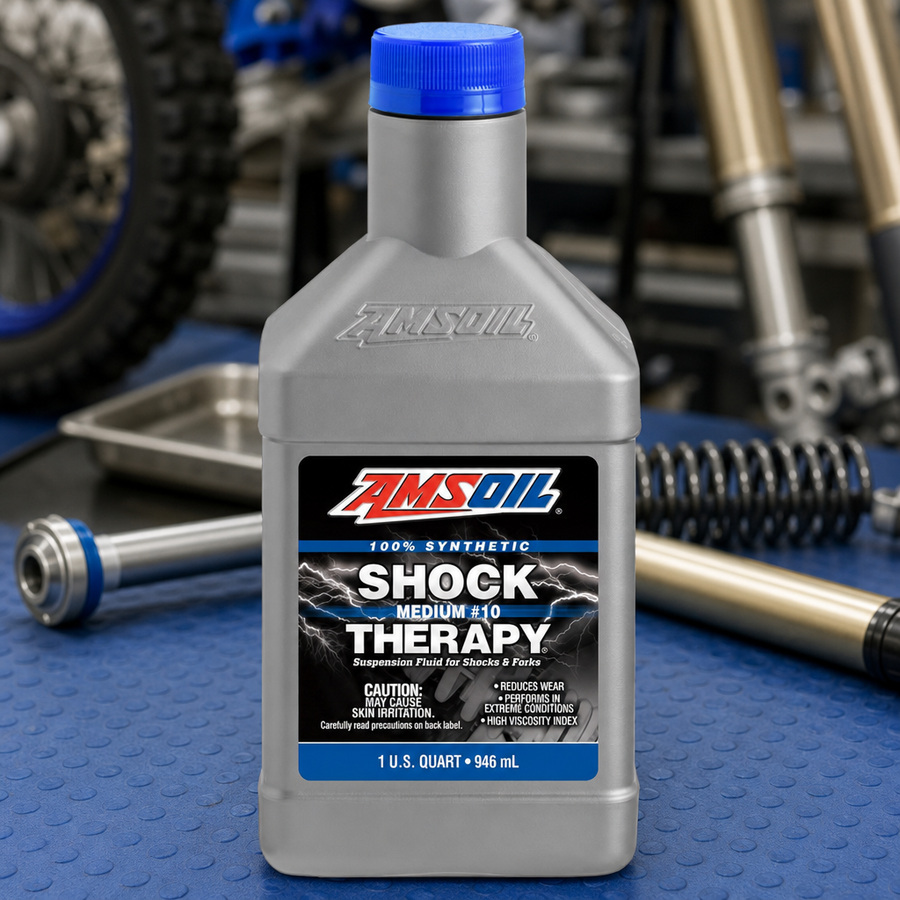
AMSOIL Shock Therapy Suspension Fluid #10 Medium
AMSOIL Shock Therapy Suspension Fluid #10 Medium is a synthetic shock and fork oil formulated for suspension systems that need firmer damping, slower rebound, and stable feel under heat. The #10 grade is the heavier of two Shock Therapy viscosities and suits cruiser fork tubes, larger sport-bike forks, race-prepped shocks, and circle-track damper builds where the tuner has dialed in a thicker fluid.
Consistent damping and rebound under heat
Aggressive riding and long racing sessions heat the fluid inside a fork or shock body, and conventional oil thins out as temperature climbs. Shock Therapy #10 Medium is built on synthetic base oils with a viscosity index of 206 (ASTM D2270), which lets the fluid hold its working viscosity from a cold launch through the back half of a long ride. Kinematic viscosity is 7.3 cSt at 100 degrees C and 31.8 cSt at 40 degrees C (ASTM D445), placing the fluid in the heavier band typical of slower-rebound builds.
Aeration and foam resistance for stable feedback
Suspension fluid that aerates loses its ability to generate damping force, because the shim stack and orifice are working on a froth of oil and air bubbles instead of solid fluid. Shock Therapy #10 Medium uses anti-foam chemistry that holds up under high-shear stroking. ASTM D892 foam testing returns 60/0, 50/0, and 60/0 across Sequences I, II, and III, indicating fast bubble collapse and minimal stable foam after agitation. For riders chasing a communicative front end, that translates into shocks and forks that recover bite quickly after big hits and stay linear deep into a stage or moto.
Wear protection for bushings, shafts, and shims
Inside a shock body or cartridge fork, sliding bushings, valve shims, and damper rod surfaces are in constant motion. Shock Therapy #10 Medium carries anti-wear additives and friction modifiers that reduce metal-to-metal contact and parasitic drag. ASTM D4172 four-ball wear testing at 40 kgf, 75 degrees C, and 1200 rpm for one hour returns a 0.42 mm scar diameter, a tight result for a viscosity-grade suspension oil. Reduced internal friction also lets the rider feel small bump compliance instead of a sticky off-the-top stroke.
Seal conditioning and wide temperature range
Fork seals and shock shaft seals dry out over time, which is the most common path to a weeping fork leg or a misted shock body. The Shock Therapy formula includes seal conditioners that help maintain elastomer pliability so the dynamic seal continues to hold pressure between rebuilds. The fluid reports a flash point of 192 degrees C (378 degrees F) and a fire point of 208 degrees C (406 degrees F) by ASTM D92, plus a pour point of negative 48 degrees C (negative 54 degrees F) by ASTM D97, covering hot summer track days and cold spring shakedowns.
Recommended applications and service intervals
Shock Therapy #10 Medium is designed for forks and shocks on snowmobiles, dirt bikes, motorcycles, ATVs, UTVs, cars, trucks, and other racing and recreational-use vehicles, particularly those operating in extreme conditions. Match the viscosity grade and fill volume to what the suspension builder or service manual specifies, then bleed the cartridge or shock the same way for each side so damping stays balanced.
- Suspension systems where more damping control and slower rebounds are desired, including those made by Fox, Koni, Ohlins, Race Tech, and WP.
- Harley-Davidson forks that call for type E or type B fork oil.
- Circle-track damper builds and other racing and recreational-use vehicles operating in extreme conditions.
- Winter and quick-rebound builds should look at the Light #5 grade instead, which carries the same chemistry at a thinner viscosity.
Service interval is driven by the suspension builder, rebuild schedule, and how hard the system is worked. Pair fresh fluid with new fork seals and a clean cartridge bath at every rebuild, agitate the bottle before pouring, and avoid mixing Shock Therapy with aftermarket viscosity modifiers or non-suspension additives. For a cross-reference against a current fork or shock oil and to map a application match from year, make, and model, the AMSOIL vehicle lookup guide is the right starting point.
Typical technical properties
| Property | Value |
|---|
| Kinematic viscosity at 100 degrees C, cSt (ASTM D445) | 7.3 |
| Kinematic viscosity at 40 degrees C, cSt (ASTM D445) | 31.8 |
| Viscosity index (ASTM D2270) | 206 |
| Flash point, degrees C (degrees F) (ASTM D92) | 192 (378) |
| Fire point, degrees C (degrees F) (ASTM D92) | 208 (406) |
| Pour point, degrees C (degrees F) (ASTM D97) | -48 (-54) |
| Four-ball wear, 40 kgf, 75 degrees C, 1200 rpm, 1 hr, scar diameter, mm (ASTM D4172) | 0.42 |
| Foam, mL (ASTM D892) Sequence I, II, III | 60/0, 50/0, 60/0 |
Buy online
Shock Therapy Suspension Fluid #10 Medium is available in multiple package sizes. Check the dirt bike oil guide for related fluid guidance, then Buy online.
Customer reviews
Worth it
Can’t be happier with this much better quality oil
By Herbert on April 18, 2026.
Would recommend this to a friend.
Great product
Great product completely changed the way my bike handles in the curves
By Matthew on September 10, 2025.
Would recommend this to a friend.
Great fluid
Was having problems with leaking fork seals cleaned them several times with no success changed out my fork oil for the Amsoil number 10 have not had any problems with leaking since then would recommend
By Bill from CO on December 07, 2023.
Would recommend this to a friend.
Read all 11 reviews
Frequently asked questions
What is the difference between Shock Therapy #5 Light and #10 Medium?
Shock Therapy #5 Light is the thinner grade, with a kinematic viscosity of 4.4 cSt at 100 degrees C, for suspension systems that want less damping and quicker rebounds; #10 Medium is the heavier grade at 7.3 cSt at 100 degrees C, for systems that want more damping control and slower rebounds. The chemistry, friction modifier package, anti-wear protection, and seal conditioners are the same; the choice between the two is a viscosity decision driven by the fork or shock build, not a quality decision.
Which suspension brands does the #10 Medium fit?
The #10 Medium is recommended for suspension systems where more damping control and slower rebounds are desired, including those made by Fox, Koni, Ohlins, Race Tech, and WP, as well as Harley-Davidson forks that call for type E or type B fork oil. Always match the fluid weight to what the suspension builder or factory service manual specifies for the application.
Can fork oil weights be mixed to get a custom viscosity?
Mixing weights is a tuning technique some suspension shops use to land on a target damping curve between two off-the-shelf grades. It works because base-oil viscosities blend predictably, but the resulting fluid will not exactly match either parent grade for foam, wear, or pour point. For a clean baseline, run a single grade and let the suspension builder change shim stacks before changing fluid blends.
How often should fork oil be changed?
The right interval depends on the platform and how hard the suspension is being used. Race forks and motocross builds often see a fluid change between events or every few hours of seat time. Street motorcycle forks are commonly serviced every 20,000 to 30,000 miles or whenever the seals are replaced; check the factory service manual or the suspension builder for the actual recommendation, and inspect the drained fluid for darkening, metallic glitter, or a milky look that indicates water ingress.
Is engine oil an acceptable substitute for fork oil?
No. Engine oil is formulated for combustion byproducts, hot bearing surfaces, and fuel dilution; it does not carry the anti-foam, seal-conditioning, and friction-modifier package a suspension fluid needs, and its viscosity grade chart is not built around fork-oil weight conventions. Substituting engine oil for a dedicated suspension fluid changes the damping curve and tends to foam aggressively under repeated stroking.
Does the AMSOIL Limited Warranty cover Shock Therapy Suspension Fluid?
Yes. Shock Therapy Suspension Fluid is covered by the AMSOIL Limited Liability Warranty, the same warranty that backs the rest of the AMSOIL lubricant line. Using AMSOIL synthetic lubricants in a vehicle does not, on its own, void a factory powertrain or chassis warranty.
Why agitate the bottle before pouring?
Suspension fluid carries an additive package, including anti-foam, anti-wear, friction modifier, and seal conditioner chemistry. Gentle agitation re-suspends those additives evenly so the fluid that enters the fork or shock matches the typical technical properties for the grade. Avoid violent shaking, which can pre-aerate the fluid before it is even installed.
Recommended applications and service intervals
Shock Therapy #10 Medium is designed for forks and shocks on snowmobiles, dirt bikes, motorcycles, ATVs, UTVs, cars, trucks, and other racing and recreational-use vehicles, particularly those operating in extreme conditions. Match the viscosity grade and fill volume to what the suspension builder or service manual specifies, then bleed the cartridge or shock the same way for each side so damping stays balanced.
- Suspension systems where more damping control and slower rebounds are desired, including those made by Fox, Koni, Ohlins, Race Tech, and WP.
- Harley-Davidson forks that call for type E or type B fork oil.
- Circle-track damper builds and other racing and recreational-use vehicles operating in extreme conditions.
- Winter and quick-rebound builds should look at the Light #5 grade instead, which carries the same chemistry at a thinner viscosity.
Service interval is driven by the suspension builder, rebuild schedule, and how hard the system is worked. Pair fresh fluid with new fork seals and a clean cartridge bath at every rebuild, agitate the bottle before pouring, and avoid mixing Shock Therapy with aftermarket viscosity modifiers or non-suspension additives. For a cross-reference against a current fork or shock oil and to map a application match from year, make, and model, the AMSOIL vehicle lookup guide is the right starting point.